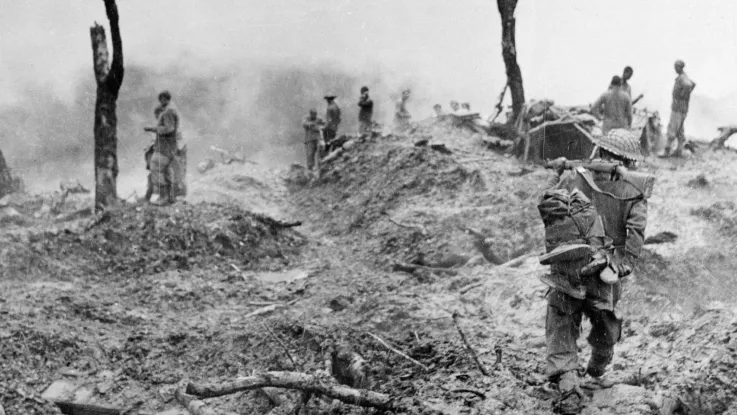
The Context
The Allies agreed that the establishment of a second front in north-west Europe was essential to defeat Germany. The Soviets had been calling for a Second Front since the German invasion of their country in 1941. But it was not until the United States entered the war, bringing its huge reserves of manpower and resources, that such an operation became feasible.
Despite considerable Soviet and American pressure for an early invasion, the British succeeded in postponing it from 1943 to 1944. They were mindful of the 1942 Dieppe fiasco, in which an Allied force had suffered disaster when attempting to assault a heavily fortified French port. The British also emphasised that the campaigns in North Africa and Italy were keeping up the pressure on the Germans. By 1944, however, the invasion could proceed - enough troops were available in Britain, more landing craft had been built and the strategic bomber offensive had worn down the German Air Force, rail network and war industry.
The Allies chose Normandy as the location for the landings. The Pas-de-Calais region offered a shorter Channel crossing, but it was heavily fortified as the Germans were expecting an attack there. Although Normandy was further from Britain, it was still within fighter range, had excellent landing beaches and was less heavily defended.
Elaborate deception plans were undertaken to convince the Germans that the main landing would be near Calais. This would reduce the flow of German reinforcements into Normandy. False information was spread by double agents, the Calais area was heavily bombed and a dummy ‘army’ was set up in eastern England opposite Calais.
Thousands of air reconnaissance photographs of the German defences were taken. Special forces teams landed on the coast to gather information. Others worked with the resistance to gather intelligence on German troop dispositions and carry out acts of sabotage against transport and communication networks.
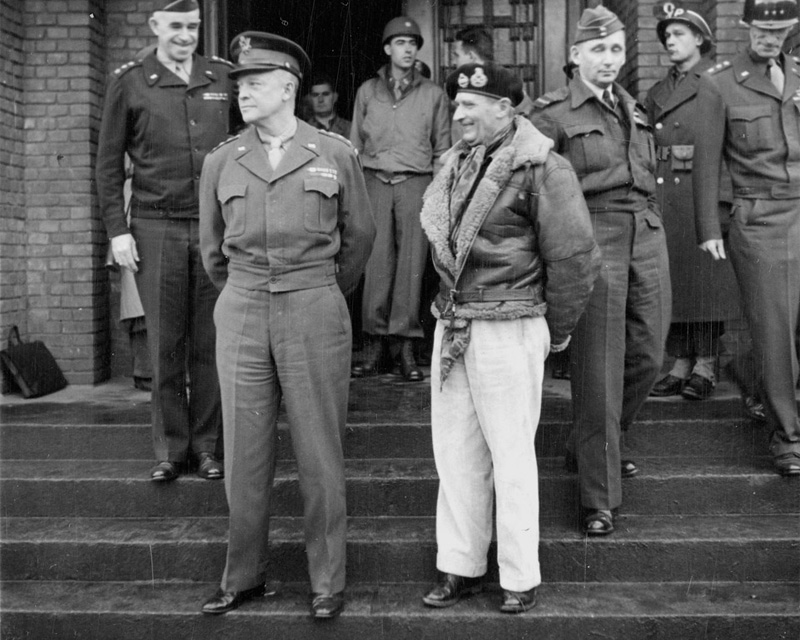
The Armies
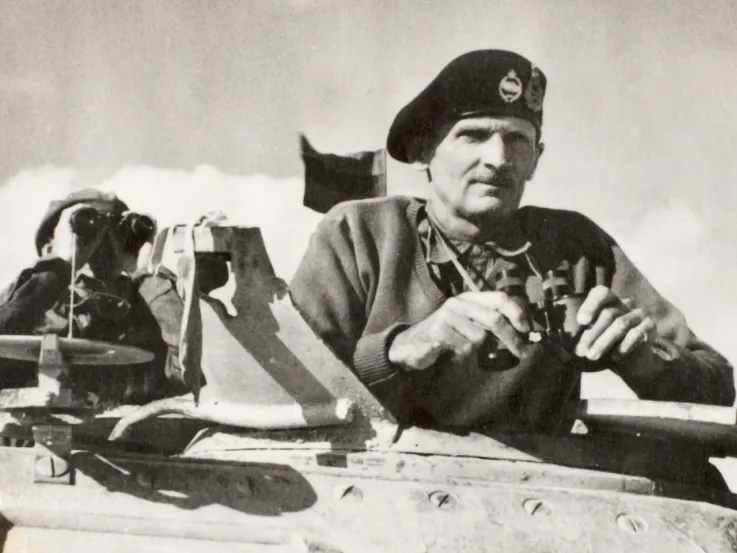
In December 1943 US General Dwight Eisenhower (1890-1969) was appointed Supreme Allied Commander for the operation, codenamed OVERLORD. British General Bernard Montgomery (1887-1976) was placed in command of the ground forces, consisting of the British Second Army and US First Army, around 160,000 men.
The Germans were commanded by Field Marshal Gerd von Rundstedt (1875-1953), the German commander-in-chief in the west, and Field Marshal Erwin Rommel (1891-1944). The German Army in the west contained over 50 divisions and included a few elite tank formations, but many of them were below strength. Only seven divisions were actually near the landing areas.
More importantly, Rommel and von Rundstedt disagreed on where the landings would take place and where their armour should be deployed. Rommel believed they should confront the invading force immediately and drive it into the sea. Von Rundstedt, believing it impossible to prevent a landing, felt the armour should be held inland where they could be used to counter-attack in force. Hitler eventually ordered the armoured reserves to be stationed in the middle, far enough inland to be unhelpful to Rommel, but not far enough for von Rundstedt’s plans.
The Battle
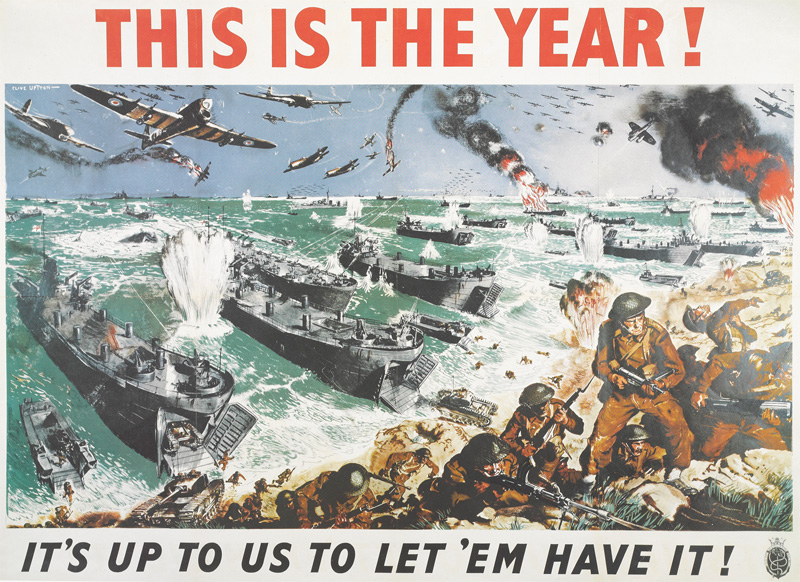
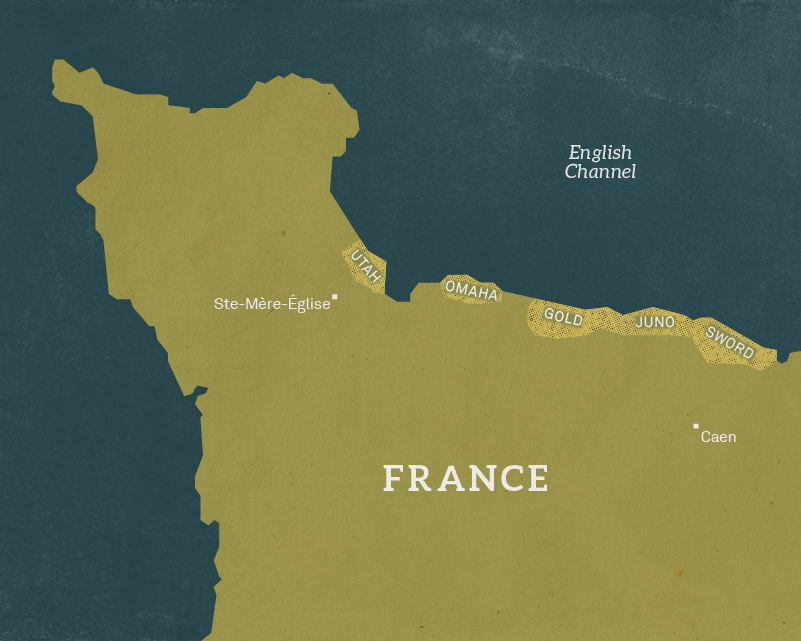
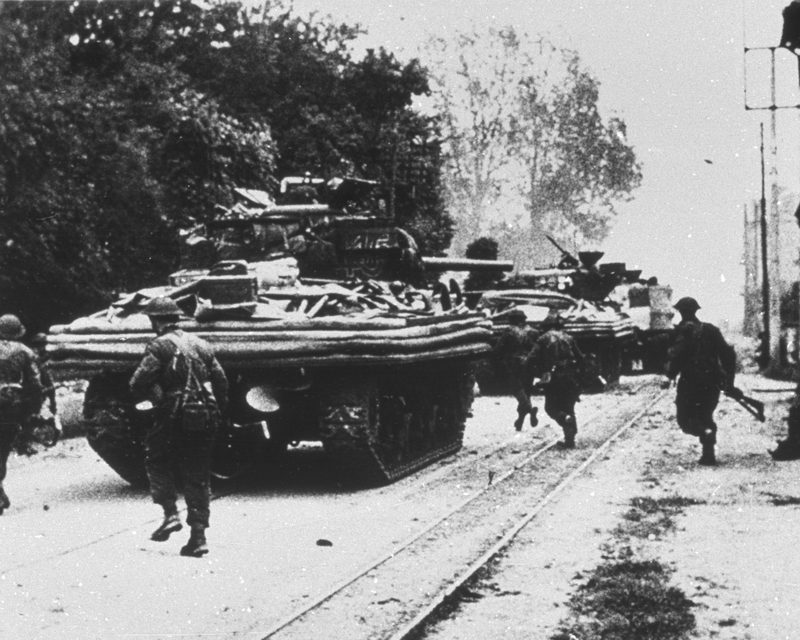
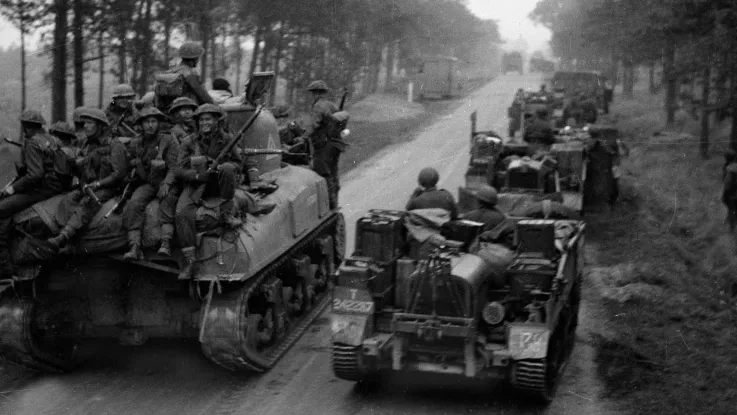
After a forced postponement due to bad weather, D-Day was set for 6 June. A fleet of over 5,000 ships and landing craft crossed the Channel. Heavy bombing together with a massive naval bombardment destroyed many of the German defences. The assault troops landed on five beach areas, codenamed Juno, Gold, Omaha, Utah, and Sword.
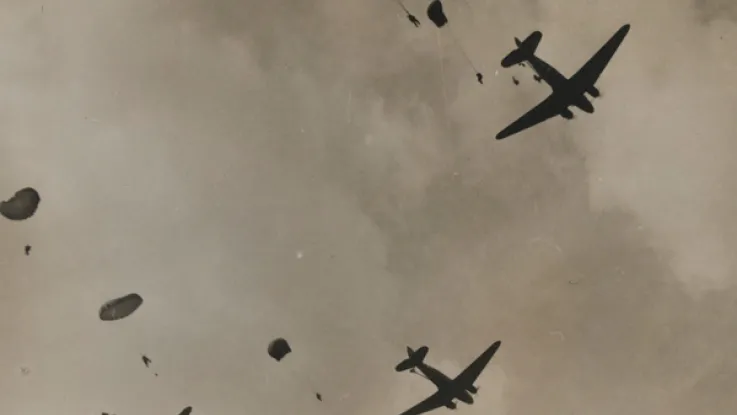
Allied airborne forces were dropped behind the beaches and on their flanks in order to slow down the Germans’ ability to counter-attack and establish a defensive screen. Key objectives, such as bridges, road crossings and coastal batteries, were seized in order to help the amphibious forces advance inland.
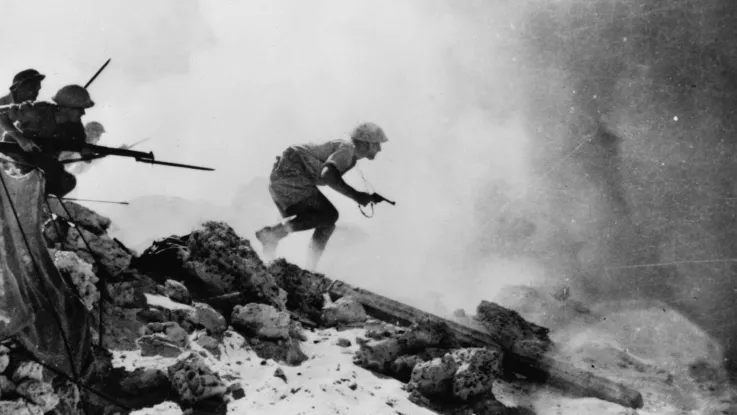
Thanks to their deception plans, the Allies achieved complete surprise. Several beaches, particularly Omaha, witnessed bloody fighting and fierce German counter-attacks, including a determined assault by 21st Panzer Division near Sword. But by the end of the day, over 130,000 troops had landed. The Allies suffered around 10,000 casualties on 6 June, far fewer than originally anticipated.
Once ashore, the Allies enjoyed a number of advantages over the Germans. They had more men, greater resources and had achieved air supremacy. Their deception plans had worked brilliantly, keeping the destination of the landings a secret and then convincing the Germans that a second, larger attack would take place elsewhere. This made them keep much-needed troops in other regions awaiting an invasion that never took place. Neither Rommel, nor von Rundstedt, could move their armoured reserves without Hitler's approval, so the initial German response was slow and poorly co-ordinated.
The British were able to break German coded radio traffic, which gave the Allies valuable information about enemy movements and intentions. They were also aided by the construction of PLUTO (Pipeline Under The Ocean), which delivered fuel to Normandy. Two prefabricated floating harbours, known as Mulberries, allowed the Allies to build up their forces more easily than the Germans, and to supply and replace them more effectively. By the end of 11 June, 325,000 troops, 54,000 vehicles and 104,000 tons of supplies had been landed.
Battle for Normandy
Despite the Allied advantages, the Germans made excellent use of the thick hedgerows of the ‘bocage’ countryside to put up a determined and skilful defence. Yet they were unable to launch a decisive counter-attack and by late June the Allies had established a solid bridgehead. The Germans were being worn down just holding the line. On 26 June the Americans captured the port of Cherbourg.
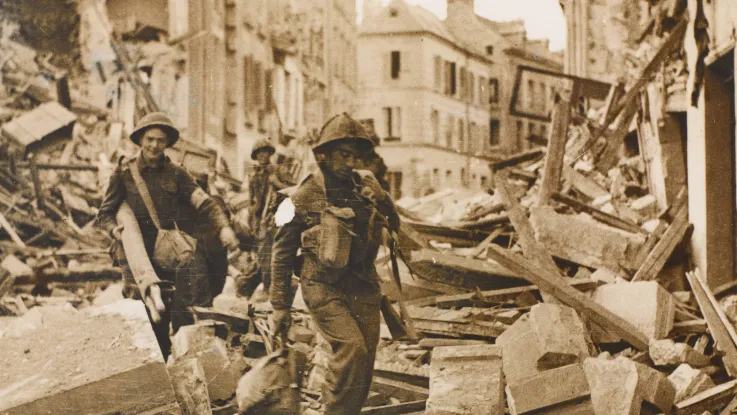
Moving inland, the Anglo-Canadian advance around Caen made slow progress, but forced the Germans to commit their best troops and most of their tanks to hold them back. Caen, which was almost totally destroyed, was finally captured after fierce fighting in July. This victory allowed the Americans to extend their bridgehead and eventually break out on 31 July around Avranches.
The Germans were now in danger of being enveloped. But, instead of allowing his forces to retreat, Hitler ordered an immediate counter-attack towards Mortain. On 7 August the Germans duly attacked, but with no air cover and limited fuel they had little chance of success. The 7th Army and 5th Panzer Army soon found themselves trapped in a shrinking pocket at Falaise, where they suffered heavy casualties from Allied artillery and air attacks. Although many of their soldiers did manage to escape, the Germans lost 60,000 men killed or captured. Nearly all their guns, tanks and vehicles were abandoned.
The Impact
German losses in the entire Normandy campaign were around 400,000. The British and Canadians suffered 84,000 casualties and the Americans 125,000. On 25 August 1944 Paris was liberated and, with the Germans in full retreat, the Second British Army and First and Third US Armies now advanced rapidly on a broad front through north-east France and Belgium towards the borders of the Third Reich.
The defeat in Normandy coincided with a devastating Soviet offensive on the Eastern Front. Germany’s strategic situation, fighting a war on two fronts against better-resourced opponents, was now hopeless. Defeat was inevitable.
The Legacy
D-Day and the Battle for Normandy are popularly regarded as the beginning of the end for Hitler and the Nazis. However, Germany's defeat would possibly have occurred without Operation OVERLORD, given the huge losses it sustained on the Eastern Front.
The landings certainly hastened the end of the war in Europe, drawing forces away that might otherwise have slowed the Red Army’s advance to Berlin. OVERLORD also ensured that the Western Allies would be firmly established in Europe at the war’s end, thus providing a counter to Soviet-backed communism at the start of the Cold War.
While the strategic legacy of the campaign is still debated, films, TV shows, computer games and books have strengthened OVERLORD’s position in the public consciousness. Films like Darryl F Zanuck’s ‘The Longest Day’ (1962) and Steven Spielberg’s ‘Saving Private Ryan’ (1998) as well as popular TV series like ‘Band of Brothers’ (2001), ensure it remains one of the best-known campaigns of the war. Every year thousands of tourists visit the sites of the landings and the nearby American and Commonwealth War Graves cemeteries.
6 March 2013, 2.22pm
No mention of Arnhem? Surely
No mention of Arnhem? Surely it deserves a mention, as does Cambrai?
2 March 2013, 4.03am
Robin, at Kursk the German HQ
Robin, at Kursk the German HQ ended assaults, when seeing no more chance of breaking thru. It was harsh losses on both sides but no devastating finish. But operative chance went off and that was important to the ongoings. For all allies. Remarkable, the Soviets calculated a 8 : 1 relation concerning tanks. The US 5 : 1. That may show the thread by 1943. Apparently Kursk isn't British.
Just to refer to nuclear weapons I think you may allow yourself to get slightly informed somewhat aside the mainstreams. Perhaps it will catch your interrest. A4/ A10. How close it was within the last 14 days of the war. Jonastal, Kammler.
By 1938 petrol was derived from black coal, by 1942 spare-butter was made from coal (awful taste but substantial), by 1943 aviation and rocket petrol was produced massively without depending on foreign means. The MG 42 threw a 1,500 rounds a minute, the Sturmgewehr 44 since 1943 (basic for AK47, G36) was an allweatherproofed 30 rounds-magazine automatic gun with a 400 meter marksmanship (not sharpshooters!) in combat, firing burst or single shot alternatively (wasn't handed out to the troops in masses for fear of costs). GPS by 1943 - Nachtjäger. By end of 1944 3 unarmoured long-distance test-rockets into the Atlantic Ocean (6.000 km range), one more seemed to be nuclear equipped exploding 20 miles off from NY (Newspaper announcements NY and Boston Jan. 1945). 5 further rockets with conventional HE beyond river Tobol (Russian armaments industry) was confirmed in 1952 by the Soviets. By 1945 four Tiger II blew 16 Sherman Tanks within 2 minutes from a 4-kilometer-distance with 128 mm guns. Bang after explosion, rarely fumes. Finally there were three Nuclear bombs being thrown onto Hiroshima and Nagasaki. Two on 6th Aug. the Nagasaki failed and was repeated on 9th Aug. The unexploded was handed out by Japan to the Soviets on 27th Aug. as the records say. Those three pieces were taken from Jonastal/ Thüringen in April 1945 (16th?) and brought to the US. In 2005 Los Alamos showed a model in 1:1 seize at an exposition. The type was recognized by an former German worker of Jonastal living then in the US. The model was immediately dropped off the exposition. The last radio-GPS-Stations of the Wehrmacht on Grönland and Labrador were captured in the late 40ies and early 50ies!
14 days prior to the end of the war Hans Kammler (SS-General and chief of S4) and Albert Speer (Rüstungsminister then) refused to Hitler launching nuclearly loaded rockets. Jonastal-region wasn't the only launch-pad. Kammler and Speer feared Germany being bombed back into Stone Age. What wasn't even much further at that moment. But they refused strictly to Hitler.
Believe that Wernher von Braun was second row of engineers at that time refferring to rocket propulsion and design. All that what was designed by physicians isn't yet mentioned. Most of that things working worldwidely today had almost been developed by 45.
It was at last a two weeks race. And the only answer was increasing bombing-power. It interrupted traffic. Material and petrol wasn't short but unobtainable in many cases.
By 1943 the SHAEF was errected when suddenly evidences about German "Wunderwaffen" were taken seriously. Fritz Kolbe revealed lots of details to Allan Welsh Dulles then Chief of OSS in Switzerland. Til 1943 the supreme allied commanders ignored Kolbe and Dulles (later CIA Director who hindered investigation on JFK's assassination) as freaks. The second front was installed then hastily.
And a miracle to D-Day is still the absentness of German units (Tanks and Specials) who were massed in proper distance and that "not reacting as normal" within the first hours under those oftenly expirienced circumstances. As if there was a wider plan.
D-Day was again a great bloodshed and all those numbers and details that we learned from schoolbooks make us drifting along and losing contact to the ongoings behind the scenes. I think the more we all know about them the closer we will come together. Perhaps a sudden enlightment will let us learn something about us normal people in England, Germany, France and elsewhere. Normal people share the same daily life, sorrows, joys and mourning about losses. Could it be that the people who are in charge -much higher than an army general- urging us to understand their way? Although they meet and laugh together and become more and more powerful and we are becomming more and more supervised?
I think if it ist obvious that Merkel and Obama trying to build a stronghold of US and EU what joke is the Cameron proposal of British referendum to quit the EU in 2018? Why not this month guys?
Here you stand proud and brave, don't let us talk about long gone battles. Whatever they did work for it wasn't for the benefit of the dead and the humilated and certainly not for the remaining living people. Convince Cameron to take your side and vote soon. The German has been diseducated for a 70 years turn, what a challenge!
What different thinking brought WW I and II to the people? If I read all the comments I can surely say: not a single commata!
One thing on politics: Britain was the second loser to the wars of 14/18 and 39/45. The last war isn't finished yet, the world is still at war as long as there's no peace treaty to Germany refferring to SHAEF laws. Which is undoubtedly chartered in the UN clauses, too!
When Lend & Lease was enacted it meant financial and economical ruin to the British Empire. As well as WW I's yield was dramatically shown by the loans Britain has to pay off to the WIB since 1919. And thus despite all options laid open to Britain. Sorry, I forgot, we the normal people have nothing to take than blood, sweat and tears - the only option for us. So you see, we've got our best in common. If soldier or burger. Even Human. You in Britain, we in Germany and I am sure - everywhere else. Vote: no! Vote soon!
Forgive me disturbing you that long! I promise improvement!
28 February 2013, 12.51pm
D day and normandy was the
D day and normandy was the pivotal battle of ww2 if the allies had failed it is likely with german scientists many years in advance in many fields that we would never retaken western europe and the freeing of so many divisions would have at least halted the russians we have to remember although germany was behind in the atomic race in conventional fields staggeringly advanced missiles. Guided missiles, jets machine guns. tanks never had one battle speeded the end of a horrible future
15 February 2013, 12.09pm
I think that the Normandy
I think that the Normandy landing was the begining of the end of the Axis powers. If we had invaded France iat the Pas de Calais it would probably been a failure. Therefore I believe that the battle for Normandy was one of our most important battles because if the Hitler had invaded in us in 1940 when he wanted to we would have definately lost!!
13 February 2013, 7.32am
Normandy, I have some 80
Normandy, I have some 80 books on the subject and have visited the landing beaches a number of times. Overlord was a great help to the Russians as the Germans moved a number of divisions to France before and after the landings. I will be in Normandy again in June 2014. When Manfred Rommel was the mayor of Stuttgart he and I corresponded a number of times.
8 February 2013, 12.46am
I agree on some points of
I agree on some points of Ronald Hanson's comment. If the landing was a failure, the Germans could have potentially unleashed a new offensive on the Russians, possibly turning the tide, but only for a short while. If d day had failed though I think the most likely outcome would either be the soviets and nazis reaching an armistice, or the Russians pushing all the way to Paris, leaving the uk in a very dangerous position with a communist mainland Europe. With the success of d day, the British were able to maintain their diplomatic status as one of the big 3 and were not excluded from the discussions of post war Europe thus making it a most important battle for the British.
3 February 2013, 6.16pm
My main comment is that the
My main comment is that the important thing about this battle is that it was successful. The threat of invasion from the west kept 168 German divisions in France to counter an invasion. If the Normandy invasion and the ensuing battle had not been a success there would have been no chance of another for many years and most of these divisions could have been moved to the Russian front with who knows what consequence. I am convinced that had Hitler had another year to develop his high tech weapons, including nuclear weapons, the tide of war could have been turned to Germany's advantage and it was only when the industrial capacity of Germany and the development and launching sites of these weapons were being over-run by the western allies that such a threat came to an end. Had most of the other battles named, although an important part of British history, had been lost there still would not have been a real threat to the British mainland.
2 February 2013, 11.09pm
The landing turned the tide
The landing turned the tide of the war.
31 January 2013, 4.47pm
To me the battle of Normandy
To me the battle of Normandy is the greatest battle and next to that the battle of Kirsk when the Russions just about finished the German Army off. Great shame the battle of Kirsk is not mentioned.
Add your comment
Please note: By submitting a comment you are agreeing to the terms laid out in the National Army Museum's Rules for User Comments. Any views expressed in user comments do not necessarily reflect or represent the views of the National Army Museum or its staff.