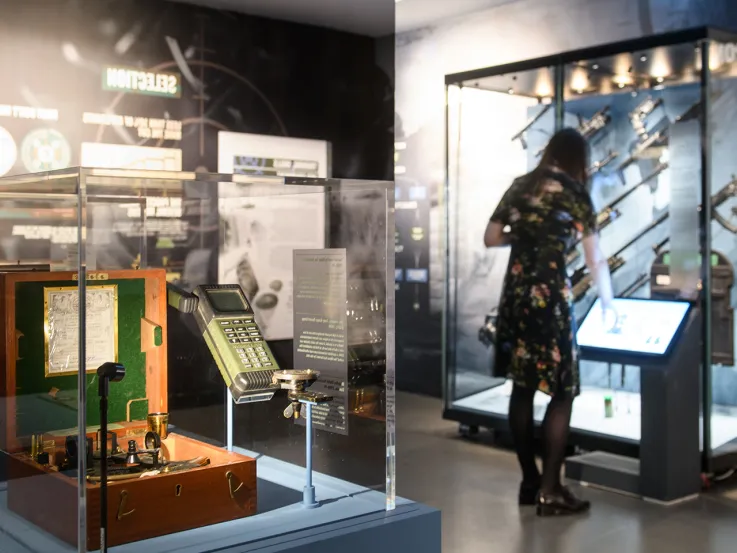
Drawn on the Western Front: Paul Sarrut and the Indian Army

30 June 2026
The National Army Museum is staging the first ever UK exhibition dedicated to Paul Sarrut, a French artist who depicted Indian soldiers during the First World War.
Generously supported by Lord Ashcroft KCMG PC
Opening on Tuesday 7 July 2026, Drawn on the Western Front: Paul Sarrut and the Indian Army is a new free exhibition exploring the experiences of Indian soldiers during the First World War. Visitors will encounter over 50 original drawings and works on paper, many exhibited publicly for the first time in over a century, alongside uniforms, photographs, archives and medals.
During the First World War, over one million Indian men volunteered to serve in the British Indian Army. In 1914 alone, more than 140,000 soldiers travelled over 4,500 miles from India to France to fight on the Western Front.
French liaison officer and interpreter Paul Sarrut served alongside them. With sketchbook constantly in hand, he created immediate and deeply human observations of military life. At the centre of the exhibition is Sarrut’s portrait of Sepoy Harnam Singh, whose image became famous in Britain during the war.
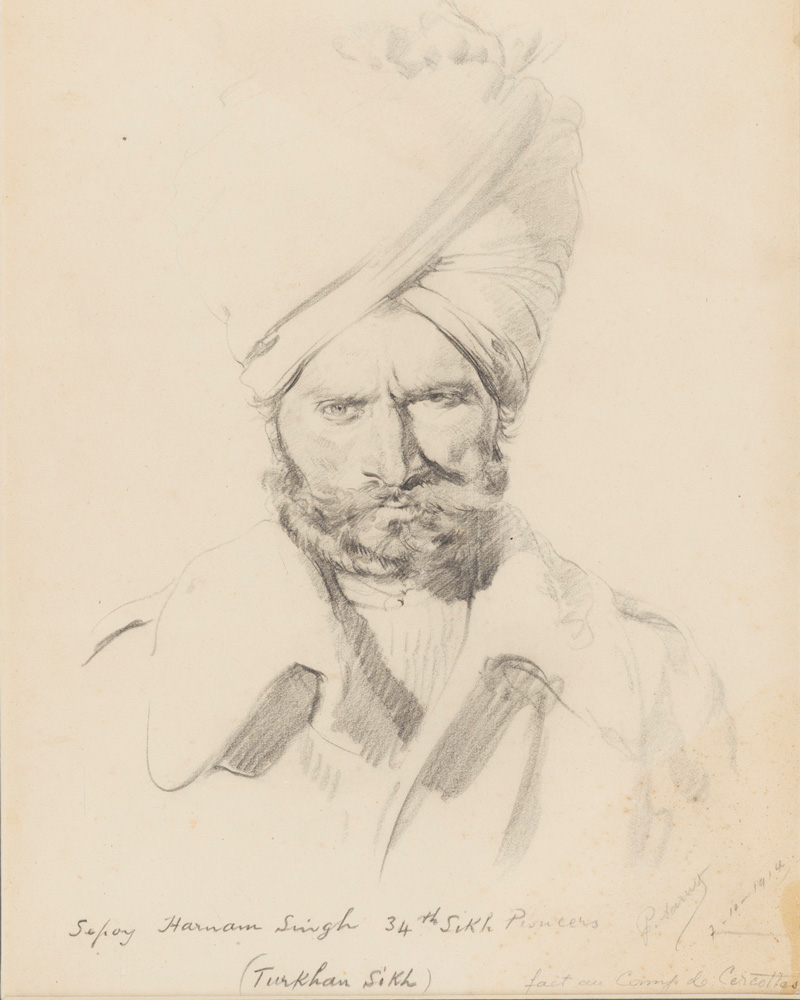
Sepoy Harnam Singh (Image courtesy of The Estate of Paul Sarrut)
Highlight objects
The exhibition explores the remarkable multicultural nature of the Indian Army, in which soldiers from what is now India, Pakistan, Britain and beyond, served and fought together.
Highlights include the Victoria Crosses awarded to Frank de Pass, the first Jewish recipient, and Khudadad Khan, who was both the first Muslim and the first soldier from the Indian subcontinent to receive the award.
Khan’s VC is on loan from Lord Ashcroft and is the first medal from Lord Ashcroft’s collection of Victoria and George Crosses to feature in a special exhibition at the National Army Museum. It is on display for the first time with Henry Charles 'Hal' Bevan-Petman’s portrait of Khudadad Khan in the Museum’s Conflict in Europe gallery.

Khudadad Khan's medal group
Justin Maciejewski, Director of the National Army Museum, said:
'As the home of Britain’s most important collection related to the pre-1947 Indian Army, we are proud to share their stories. The Indian Corps played a vital part in the opening months of the First World War, and the soldiers depicted by Paul Sarrut illustrate their service and lives in a unique way.
'We are delighted to display together the Victoria Crosses awarded to Khudadad Khan, the first Muslim and first soldier from the Indian subcontinent to receive the award, and Frank de Pass, the first Jewish recipient. Khan’s medal is on loan from Lord Ashcroft’s collection of Victoria Crosses and George Crosses, and we are grateful for his continued generosity and commitment to sharing stories of extraordinary gallantry and valour. Together, these medals are a powerful and inspiring reminder of the courage shown by soldiers of many faiths and backgrounds who served in the Indian Corps during the First World War.'
Lord Ashcroft KCMG PC, said:
'I am delighted that Subadar Khudadad Khan's medal group is going on display at the National Army Museum as part of this important and ground-breaking exhibition.
'Subadar Khan was both the first Muslim and the first British Indian to be awarded the Victoria Cross and so this is a significant medal group for these reasons. Furthermore, the courage that this soldier displayed at the Battle of Ypres during the first year of the First World War was quite incredible. His gallantry deserves to be championed far and wide. It is also important to recognise that many loyal and brave Muslims have risked, and sometimes given, their lives for Britain, its allies and for wider freedoms.'
Anna Lavelle, the exhibition’s lead curator, said:
'What makes Sarrut’s work so compelling is its immediacy. He was living among the soldiers he drew and capturing moments as they happened: resting, reading, waiting, recovering. The sketches feel deeply personal and unguarded. They reveal aspects of military life that are often absent from official wartime imagery and help us connect emotionally with people living through extraordinary circumstances more than a century ago.'

Paul Sarrut, c1915 (Image courtesy of The Estate of Paul Sarrut)
Rare perspectives
Central to the exhibition are 13 drawings acquired in 2021 with support from Art Fund. Following the war, a selection of Sarrut's sketches was reproduced as a series of lithographic prints, helping to preserve some of his observations of Indian soldiers on the Western Front.
None of these 13 works were reproduced in Sarrut’s published lithograph series, making them unique survivals and important additions to the Museum’s collection. Together, they offer rare perspectives on the experiences of Indian soldiers on the Western Front and deepen our understanding of Sarrut’s remarkable visual record of the First World War.
The Museum’s curators have worked closely with Paul Sarrut’s descendants, who shared family photographs that have helped bring the artist's personal story to the exhibition. These rare images offer a glimpse of Sarrut's life beyond his wartime sketches, and present a fuller picture of the artist’s life.
This is the first major exhibition dedicated to Paul Sarrut and the only opportunity to see the National Army Museum’s collection displayed together. Due to the fragility of the works on paper, many are unlikely to be shown again for many years.
Drawn on the Western Front: Paul Sarrut and the Indian Army is free and open at the National Army Museum from Tuesday 7 July 2026 to Sunday 27 February 2027.
Generously supported by Lord Ashcroft KCMG PC
Note to editors
For more information and images, please contact:
- National Army Museum Communications Team: press@nam.ac.uk
Join in the conversation on:
- X: @NAM_London
- Facebook: facebook.com/NationalArmyMuseum
- Instagram: @nam_london
National Army Museum
The National Army Museum shares the history and heritage of our soldiers and their service in the Army, across the globe and down the centuries. Through our collections we explore the history of the Army from its origins to the present day. We aim to engage and inspire everyone with the stories of our soldiers and how their service shapes our world; past, present and future.
Explore further

Press releases