Captain John Nicholson, 77th Regiment of Foot, c1855
Early portraits
The daguerreotype was the first publicly available photographic process, gaining prominence during the early Victorian period of the 1840s and 1850s.
Coloured daguerreotypes formed a bridge between traditional portrait painting and this new photographic medium. Like traditional painted portraits, daguerreotypes were also commonly displayed in decorative frames.
In the portrait of Captain John Nicholson below, his stance and carefully arranged pose are strongly reminiscent of a painting. Nicholson served in the 77th Regiment of Foot during the Crimean War (1854–56). Recently promoted and a new father, he was killed in action at the Battle of Inkerman.
Expensive to produce, daguerreotypes were largely the preserve of officers and wealthier individuals. Most examples in the National Army Museum’s collection reflect the exclusivity of early photographic portraiture.

Coloured daguerreotype of Captain John Nicholson, c1855

Hand-coloured ambrotype of an unnamed soldier, c1855
Growing access
New processes soon began to broaden access to portrait photography. Ambrotypes were developed in the early 1850s using cheaper materials and techniques. They helped make portraits increasingly affordable.
The ambrotype above, capturing an unnamed private soldier of the 77th Regiment of Foot, includes gold-coloured paint to accentuate details such as the buttons and belt buckle.
Seen alongside Nicholson’s portrait, the image also highlights differences in status within the Victorian Army. The elaborate uniform of the officer contrasts sharply with the much plainer appearance of the ordinary soldier.

Oil painting of Major-General John William Ormsby, 1869

Portrait photograph of Prince George, Duke of Cambridge, c1861
The great and the good
Photography inherited many of the conventions of painted portraiture. Victorian military portraits often presented celebrated commanders in heroic or carefully staged poses, echoing artistic traditions that stretched back centuries.
The two images above – of Major-General Ormsby and Prince George, 2nd Duke of Cambridge – demonstrate this continuity in composition. Both men wear elaborate uniforms, face in the same direction and adopt a near-identical leaning stance, traditionally used to convey an air of relaxed authority.
During the 19th century, the ‘great man theory’ became increasingly popular. It emphasised the supposed superior qualities of exceptional individuals such as Napoleon Bonaparte and Oliver Cromwell. Field Marshal Lord Kitchener became one of the most recognisable military figures associated with this idea.
By the time the studio portrait below was taken in 1901, Kitchener’s exploits in Sudan and the Boer War (1899–1902) had already made him a household name.
During the First World War (1914–18), his image would be disseminated widely across the British Empire, primarily to boost military recruitment, but also as a powerful propaganda symbol.

Portrait photograph of Field Marshal Lord Kitchener, c1901
Ordinary heroes
Yet photography also preserved the stories of less celebrated individuals whose bravery might otherwise have gone undocumented.
One such figure was Annie Fox, wife of Quartermaster George Fox of the 94th Regiment of Foot. During the Battle of Bronkhorstspruit in the Transvaal War (1880–81), she attended to wounded soldiers under fire despite being wounded herself.
Fox received the Royal Red Cross for her bravery, but died in 1888 from the effects of her injuries. Although a civilian, she was buried with full military honours at the command of Queen Victoria.
Alongside portraits of famous commanders and imperial heroes, photographs like the one below reflect a growing public interest in the personal experiences and sacrifices of individuals connected to the Army.

Portrait photograph of Annie Fox, 1883
Group portraits
As photography became more affordable and portable, it was increasingly used to capture the social structures and relationships within Army life – comradeship, hierarchy and regimental identity, as well as individual achievement.
Army group portraits from the earlier Victorian period often appear less formal than later examples, with smaller groups photographed in outdoor settings. More often than not, these groups consist of officers or senior non-commissioned officers, with the highest-ranking figures placed prominently at the centre of the composition.
The group portrait below shows British and Indian officers of Queen Victoria’s Own Corps of Guides around the time of the Second Afghan War (1878–80). The Indian Army played a crucial role in maintaining and expanding the British Empire, providing a huge reserve of manpower during colonial campaigns and local uprisings.

Group portrait photograph of British and Indian officers of Queen Victoria's Own Corps of Guides, 1879
Team spirit
Group portraits of other ranks from this period often have a distinctly sporting feel. This image shows the tug-of-war team of No 9 Company, Eastern Division, Royal Garrison Artillery, photographed in India in 1901.
The British Army promoted organised sport as a way of building physical strength while also encouraging discipline, co-operation and teamwork. During the Victorian era, mass participation in sport grew rapidly, although many activities – including hunting, horse riding and sailing – remained closely associated with the privileged classes.

Tug-of-war team of No 9 Company Eastern Division, Royal Garrison Artillery, India, 1901
Families
For centuries, large painted family portraits had been associated with wealthy households and aristocratic status. The growing affordability of photography, however, allowed families of more modest means to commission their own portraits.
This well-turned-out family, photographed in the mid-1870s, consists of a senior non-commissioned officer standing beside his wife and five children.
In contrast, the group portrait of officers and their families attending the Commander-in-Chief’s luncheon party in Delhi in 1885 demonstrates the relative luxury enjoyed by the middle and upper classes of Victorian society.
During the British Raj (1858–1947), many officers stationed in India brought their families with them. This image presents an idealised version of imperial life, complete with Indian servants and an elephant. This was a world far removed from the everyday experiences of most soldiers.

Family portrait photograph, c1875

The Commander-in-Chief's luncheon party, Delhi, c1885
Reporting from the front
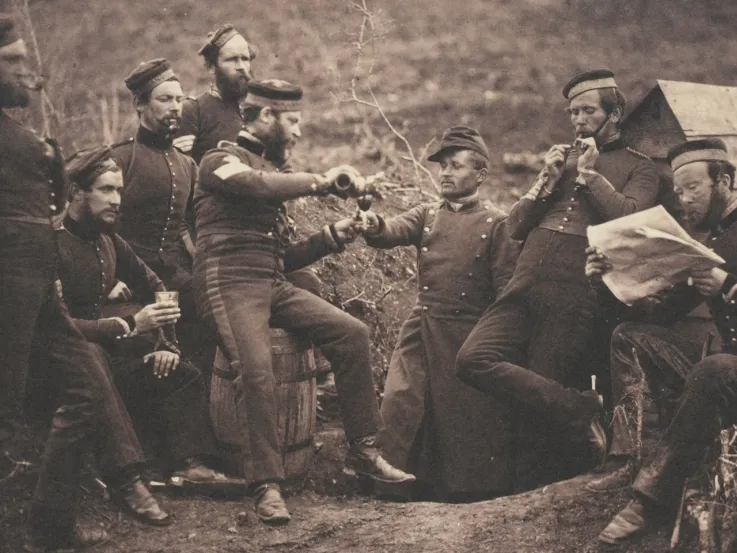
The Crimean War (1854–56) marked the first systematic photographic documentation of a major conflict. Professional photographers such as Roger Fenton, alongside reporters including William Howard Russell of ‘The Times’, helped bring images and accounts from the front line to audiences at home.
Reports of disease, poor conditions and bitter weather – highlighted by figures such as Florence Nightingale – contributed to changing public perceptions of the common British soldier. Increasingly, he was portrayed not as an object of ridicule, but as a figure of endurance and sacrifice.
Photography itself, however, still faced major technical limitations. Long exposure times made it impossible to capture active combat, forcing photographers to focus instead on posed portraits, camp scenes and landscapes.

Captain Brown of the 4th (The Queen's Own) Regiment of Light Dragoons, in camp with his servant, both wearing winter dress, Crimea, c1855 (Photograph by Roger Fenton)
Life on campaign
As photographic technology improved, images became less formal and increasingly focused on the everyday realities of military life.
Taken in Kashmir in 1888, the photograph below shows members of the Royal Engineers Telegraph and Postal Group relaxing in camp while their servants stand nearby.
The Royal Engineers played an important role in developing military communications during the Victorian period, including telegraph systems first used extensively during the Crimean War. Photographs such as this reflected growing public interest in the lived experiences of soldiers serving across the British Empire.

Corps of Royal Engineers Telegraph and Postal Group, Kashmir Contingent, 1888
Amateur photography
By the time of the Boer War (1899–1902), newspapers and illustrated magazines were reporting heavily on military events. This expansion of visual reporting was accompanied by the rise of amateur photography, which was accelerated further by the introduction of the Kodak Brownie camera in 1900.
Cheap, portable and easy to use, the Brownie helped bring photography to a mass audience. Large numbers of photographs were now being taken not only by professionals and journalists, but also by soldiers themselves.
A young Winston Churchill – already partial to a cigar, judging by the photograph below – used his growing fame as a writer to secure a posting to South Africa as a war correspondent for ‘The Morning Post’.
In November 1899, Churchill was with a British Army reconnaissance mission when their armoured train was ambushed by Boer forces. Captured during the attack, he escaped from a prison camp a month later and travelled 300 miles to safety in Portuguese Mozambique. After rejoining the Army, he took part in the relief of Ladysmith and the capture of Pretoria.
These exploits helped establish his public reputation and demonstrated the growing relationship between warfare, celebrity and mass media.

Winston Churchill in South Africa, c1900
Official documents
As photography became more widespread, some regiments appointed official photographers to document their service, traditions and personnel. These images became an important source of regimental pride and identity, shaping how military units presented themselves to a wider public.
The portrait below of a young drummer in the Scots Guards was taken in 1906 by Christina Broom. He stands proudly in full dress uniform, including his bearskin cap, with elaborate ‘drummer’s lace’ decorating his tunic.
Broom was a pioneering female press photographer who produced more than 40,000 images under the professional name Mrs Albert Broom. Appointed official photographer to the Household Division in 1903, she held the role until her death in 1939.

Official photograph taken by Mrs Albert Broom, c1906
Commercial photography
Photography also became an increasingly commercial enterprise during the Victorian period.
Stereoscopic photography grew rapidly after Queen Victoria and Prince Albert were impressed by examples at the Great Exhibition of 1851. Viewed through a handheld stereoscope, two slightly different images created the illusion of depth, producing a striking three-dimensional effect.
The American company Underwood & Underwood produced thousands of images during the Boer War. By 1901, the company was reportedly manufacturing around 25,000 stereoscopic cards every day.
This stereoscopic image of Lord Roberts VC, published by Underwood & Underwood in 1900, demonstrates how military celebrity could now be reproduced and sold on a mass scale.

'Lord Roberts, hero of Candahar [sic] and South Africa, Commander-in-Chief of British Armies', c1900
Souvenirs
By Queen Victoria’s death in 1901, the British Army had expanded from around 88,000 soldiers at the start of her reign to more than 275,000 men. Over the same period, photography had evolved from an elite novelty into a mass medium.
By the outbreak of the First World War in 1914, it had become common for soldiers of all social backgrounds to have their photograph taken in uniform. Many of these portraits were produced as inexpensive postcards that could easily be shared with friends and relatives.

Postcard photograph of Private Archibald John Favell, The Royal Fusiliers (City of London Regiment), November 1914
Legacy
During Victoria’s reign, photography transformed how soldiers were represented, remembered and understood by the public.
From formal studio portraits of wealthy officers to affordable postcards carried by ordinary soldiers, photography helped create a new visual culture of military service that would continue into the 20th century and beyond.
Enjoyed this story?
Visit our special exhibition Myth and Reality: Military Art in the Age of Queen Victoria to explore how artists and imagery shaped public attitudes towards Britain’s soldiers.