Gallantry
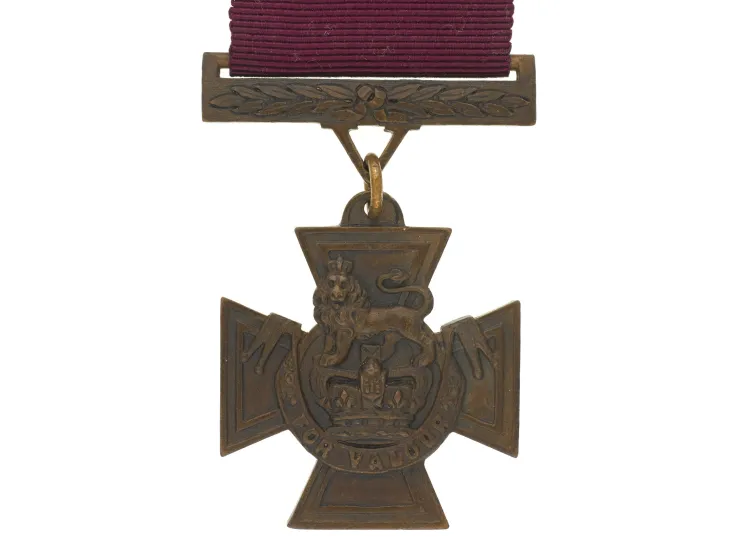
Gallantry awards honour exceptional courage in dangerous situations. The George Cross and Victoria Cross are equal in status as Britain’s highest awards for gallantry. The key difference lies in the circumstances of the action.
The Victoria Cross is awarded for acts of valour carried out under military command and in the presence of the enemy. The George Cross is awarded for acts of heroism carried out in situations of extreme danger but not in direct combat.
Since 1940, more than 400 George Crosses have been awarded to civilians and members of the armed forces. Each award is formally announced in ‘The London Gazette’, the official public record of the British government.
Recipients are entitled to use the post-nominal letters ‘GC’.

‘Whereas We have taken into Our Royal consideration the many acts of heroism performed both by male and by female persons, especially during the present war: And whereas We are desirous of honouring those who perform such deeds: We do by these presents for Us, Our Heirs and Successors institute and create a new Decoration which we desire should be highly prized and eagerly sought after.’Recorded in ‘The London Gazette’ — 31 January 1941
Origins
The George Cross was instituted by King George VI on 24 September 1940, at a time when Britain was at war and people across the country faced the relentless threat of German bombing raids.
The King wanted a decoration that recognised the heroism shown not only by those serving in the military, but by ordinary people responding to wartime emergencies.
Several civilian gallantry awards already existed before 1940. The Albert Medal recognised lifesaving at sea and later on land, while the Edward Medal honoured acts of bravery in mines, quarries and other industrial settings. The Empire Gallantry Medal was awarded for exceptional courage outside direct enemy action.
The introduction of the George Cross simplified this system by creating a single decoration for acts of bravery in non-combat situations.
Holders of the Empire Gallantry Medal were invited to exchange it for the new decoration. Recipients of the Albert Medal and Edward Medal were later also permitted to exchange their awards.

Detail of the George Cross's design

Example of the information engraved on the reverse
Design
The medal is a four-armed cross made of silver, suspended from a dark blue ribbon. Above the ribbon sits a bar decorated with laurel leaves.
At the centre of the design is an image of St George fighting a dragon, surrounded by the words ‘For Gallantry’. The royal cypher of King George VI features between each arm of the cross.
The reverse is simpler, bearing the recipient’s name and the date of the award. For members of the armed forces, it can include additional details, such as rank and regiment.
The medal was designed by artist and sculptor Percy Metcalfe, who was responsible for a wide range of other awards and coins during the 20th century.
Eligibility
From the outset, the George Cross was intended to recognise bravery across society, regardless of gender, profession or military rank.
The original Royal Warrant states that it is ‘primarily for civilians’ and that, for those serving in the armed forces, it should be ‘confined to actions for which purely military honours are not normally granted’.
The award is reserved for acts of the highest heroism or of the most conspicuous courage in circumstances of extreme danger.
Although a British decoration, it has always been open to people from across the Empire and Commonwealth.
Today, recommendations for the award are considered by the George Cross Committee. This includes senior representatives of the Government and the Royal Household, as well as independent members.

Thomas Alderson GC, c1941 (IWM: HU 66004)
The first award
The first recipient of the George Cross was Thomas Alderson, an air raid warden who took part in rescue operations following a German bombing raid on the seaside town of Bridlington, East Yorkshire, in August 1940.
Alderson was involved in several missions to rescue civilians trapped in damaged buildings. His citation recorded that, on one occasion, he tunnelled ‘13 to 14 feet under the main heap of wreckage’ to save the lives of six people. His actions set the standard for the courage the George Cross would come to represent.
The following examples show some of the acts of bravery performed by George Cross recipients operating in military roles.
Bombardier Herbert Reed
Royal Artillery
In June 1941, Bombardier Herbert Reed was serving aboard the merchant ship SS ‘Cormount’ when it came under attack off the east coast of England. The ship was part of a convoy carrying essential wartime coal supplies to London.
While operating anti-aircraft guns, Reed was seriously wounded in the stomach. However, he remained at his post and later rescued an injured officer from the ship’s burning bridge.
Reed died from his wounds and was posthumously awarded the George Cross. His medal is on display in the Army at Home gallery.

Bombardier Herbert Reed's George Cross on display

Violette Szabo
Women’s Transport Service (FANY)
Violette Szabo served as an agent of the Special Operations Executive (SOE) in occupied France during the Second World War. She had joined the Women’s Transport Service (FANY) to disguise this covert role.
In June 1944, while co-ordinating with local resistance groups near Limoges, Szabo was stopped at a German roadblock. After a prolonged gunfight, she was captured and interrogated by the Gestapo, but refused to give up any information. She was later sent to Ravensbrück concentration camp, where she was executed in early 1945.
Szabo was posthumously awarded the George Cross in 1946. Her citation praised her ‘great presence of mind and astuteness’.
Trooper Christopher Finney
The Blues and Royals
On 28 March 2003, Trooper Christopher Finney was serving in Iraq when the Scimitar reconnaissance vehicle he was driving came under sudden attack.
After freeing himself from the burning vehicle, Finney realised the gunner was still trapped inside. He immediately returned and pulled his comrade to safety.
Despite subsequently suffering injuries to his back and legs, Finney attempted to rescue the driver of a second Scimitar that had also been fired on.
He was awarded the George Cross for his exceptional courage and selflessness.

Trooper Christopher Finney GC, 2004 (© Crown Copyright)
Collective awards
The George Cross has been awarded collectively on three occasions.
- 1942: the island of Malta (a British Crown Colony at the time) was recognised for the resilience shown by its people during the Second World War.
- 1999: the Royal Ulster Constabulary received the award for its service during ‘the Troubles’ in Northern Ireland.
- 2021: the National Health Service (NHS) was honoured for its long history of ‘courage, compassion and dedication’, including its response to the Covid-19 pandemic.
A symbol of courage
The George Cross remains one of Britain’s most powerful symbols of courage, with a remarkable story behind each medal.
Whether awarded to soldiers on campaign, agents operating behind enemy lines, or civilians responding to extraordinary circumstances, it demonstrates that gallantry can be found wherever people face extreme danger.