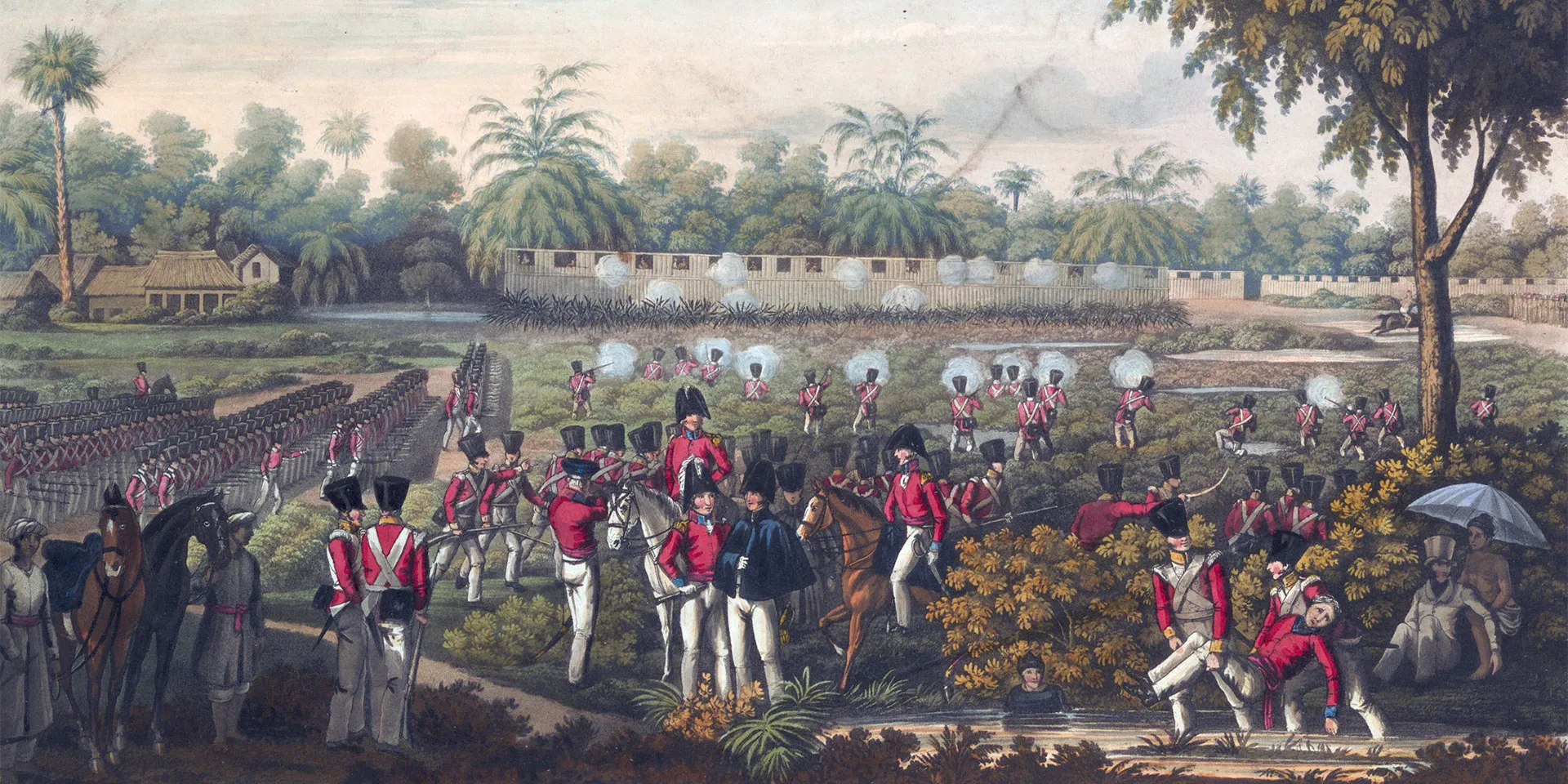
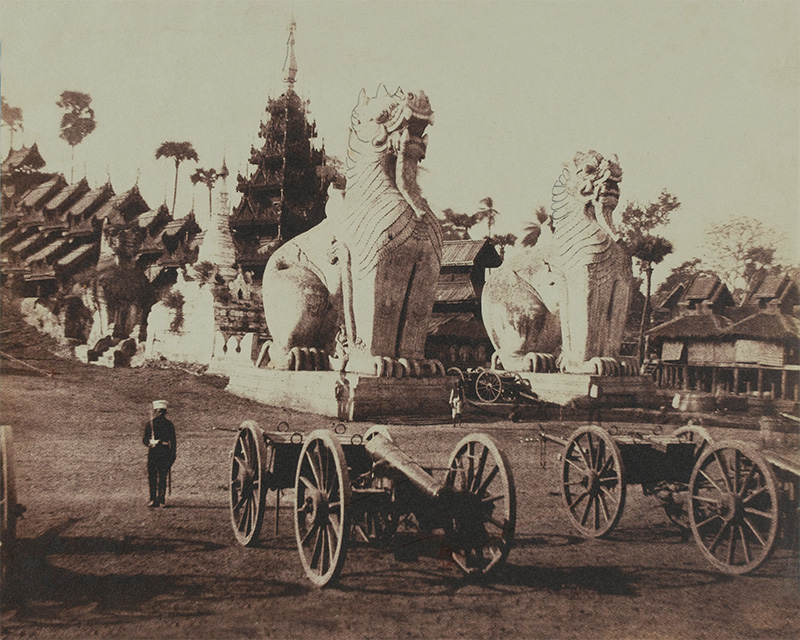
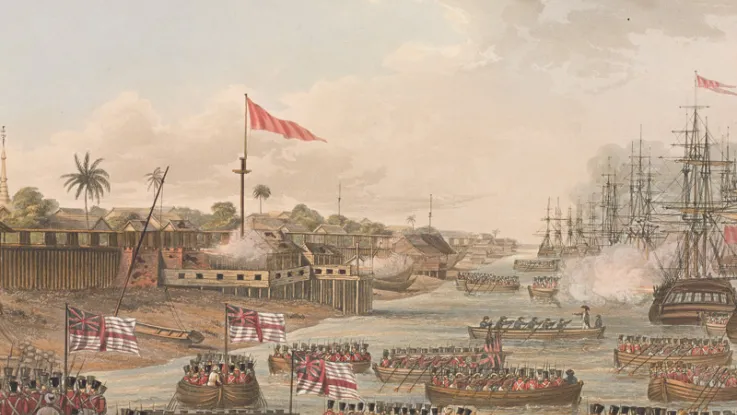
Attack upon the teak stockades near Rangoon led by General Sir Archibald Campbell, 28 May 1824
1784
Burmese conquest of Arakan
King Bodawpaya of Burma conquers Arakan (now Rakhine State in Myanmar), bordering the British-administered district of Chittagong (in modern-day Bangladesh). This marks the beginning of frontier disputes between the two powers.
1819–21
Expansion into Assam and Manipur
Bodawpaya dies in 1819. His successor, King Bagyidaw, sends an army led by Maha Bandula to occupy the state of Manipur. The Burmese forces follow up their victory by taking Assam in 1821.
1824–26
First Burma War
Following further territorial disputes, Burmese forces in Assam make a successful incursion into the state of Cachar, bordering the Indian district of Dacca (now Dhaka in Bangladesh). Emboldened by success, King Bagyidaw gives Maha Bandula orders to attack British-held territory in Northeast India. On 5 March 1824, Lord Amherst, Governor General of India, declares war.
May–December 1824
Battle of Rangoon
As the conflict progresses, a seaborne expedition lands at Rangoon (now Yangon) almost unopposed on 11 May 1824. This military force, comprising two divisions from the East India Company’s Bengal and Madras armies, is led by General Sir Archibald Campbell.
February 1826
Battle of Pagan
After the death of Maha Bandula at the Battle of Danubyu in 1825, British forces push steadily up the River Irrawaddy towards the royal capital at Ava (now Inwa). Last-ditch fighting takes place among the pagodas at Pagan (now Bagan), signalling the end of organised Burmese resistance.
24 February 1826
Treaty of Yandabo
The First Burma War ends with the signing of the Treaty of Yandabo. The Burmese agree to pay a large indemnity and to cede Arakan, Assam, Manipur and Tenasserim (now Tanintharyi) to the British.
23 November 1826
Crawfurd Commercial Treaty
The signing of this limited agreement does little to facilitate trade. However, it guarantees the security of British commerce for the time being.

‘There is no country in the east so well situated for an inlet to our trade and under a better form of government, a ready market would be found for a large consumption of British merchandise, as there is scarcely an article of dress among the natives, that is not already British, or certain to become so.’Extract from ‘Narrative of the Burmese War’ by Major John Snodgrass, military secretary to Major General Sir Archibald Campbell and assistant political agent in Ava — 1827
1852–53
Second Burma War
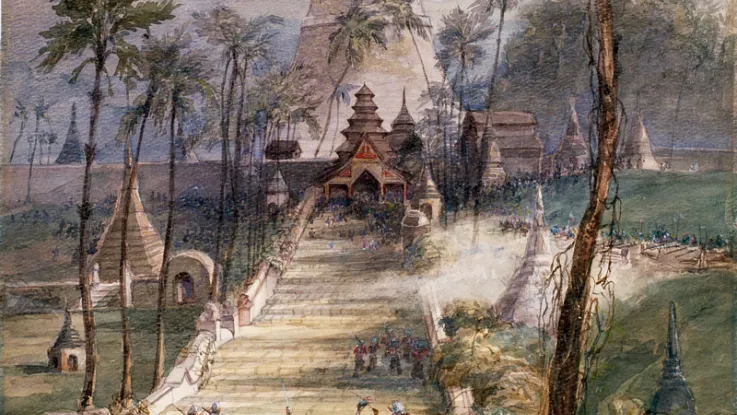
Trading disputes, in particular the harassment of British merchants and the imprisonment of two British sea captains without trial, lead to a renewal of hostilities. Lord Dalhousie, Governor General of India, sends an ultimatum to King Pagan and a force comprising two brigades of British, Madras and Bengal infantry is assembled under the command of Lieutenant General Sir Henry Godwin.
January 1853
Annexation of Lower Burma
The Second Burma War lasts only a few months, with the Burmese defeated at Martaban (now Mottama), Rangoon, Bassein (now Pathein) and Pegu (now Bago). On 20 January 1853, Lord Dalhousie proclaims the annexation of the lower Irrawaddy valley, giving the British control over a wealth of natural resources.
1862
Formation of British Burma
Following the transfer of power from the East India Company to the British Crown in 1858, Britain begins to consolidate the administration of its Burmese territories. The coastal regions acquired in 1826 and the recently annexed lower Irrawaddy valley are brought together to form a new chief commissioner's province known as British Burma.
1874
Chief Commissioner's Province of Assam
Further administrative reorganisation sees Assam separated from the Bengal Presidency to become a distinct chief commissioner’s province, sometimes referred to as the North-East Frontier. Manipur is the only one of the territories ceded to the British in 1826 to retain at least nominal independence.
1885–95
Third Burma War
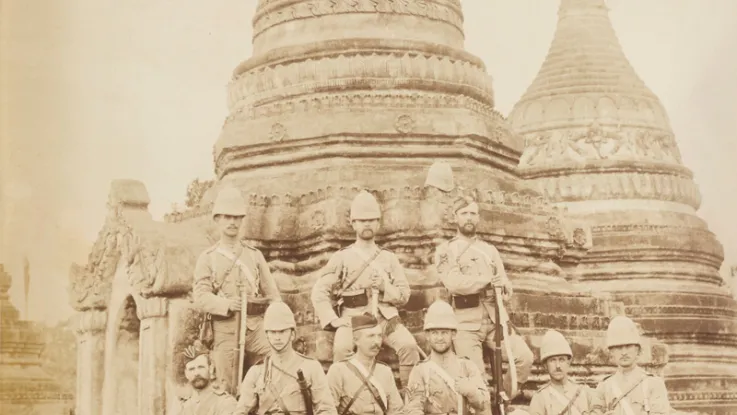
Further trading disputes, plus growing alarm at French influence in the Burmese court, prompt Britain to launch a third campaign. A division-sized force of British soldiers and troops from the Madras and Bengal Presidencies, led by Major General Harry Prendergast VC, crosses into Upper Burma on 11 November 1885. The expedition advances upriver towards the new royal capital at Mandalay, defeating the Burmese at Minhla six days later.
29 November 1885
Fall of the Konbaung dynasty
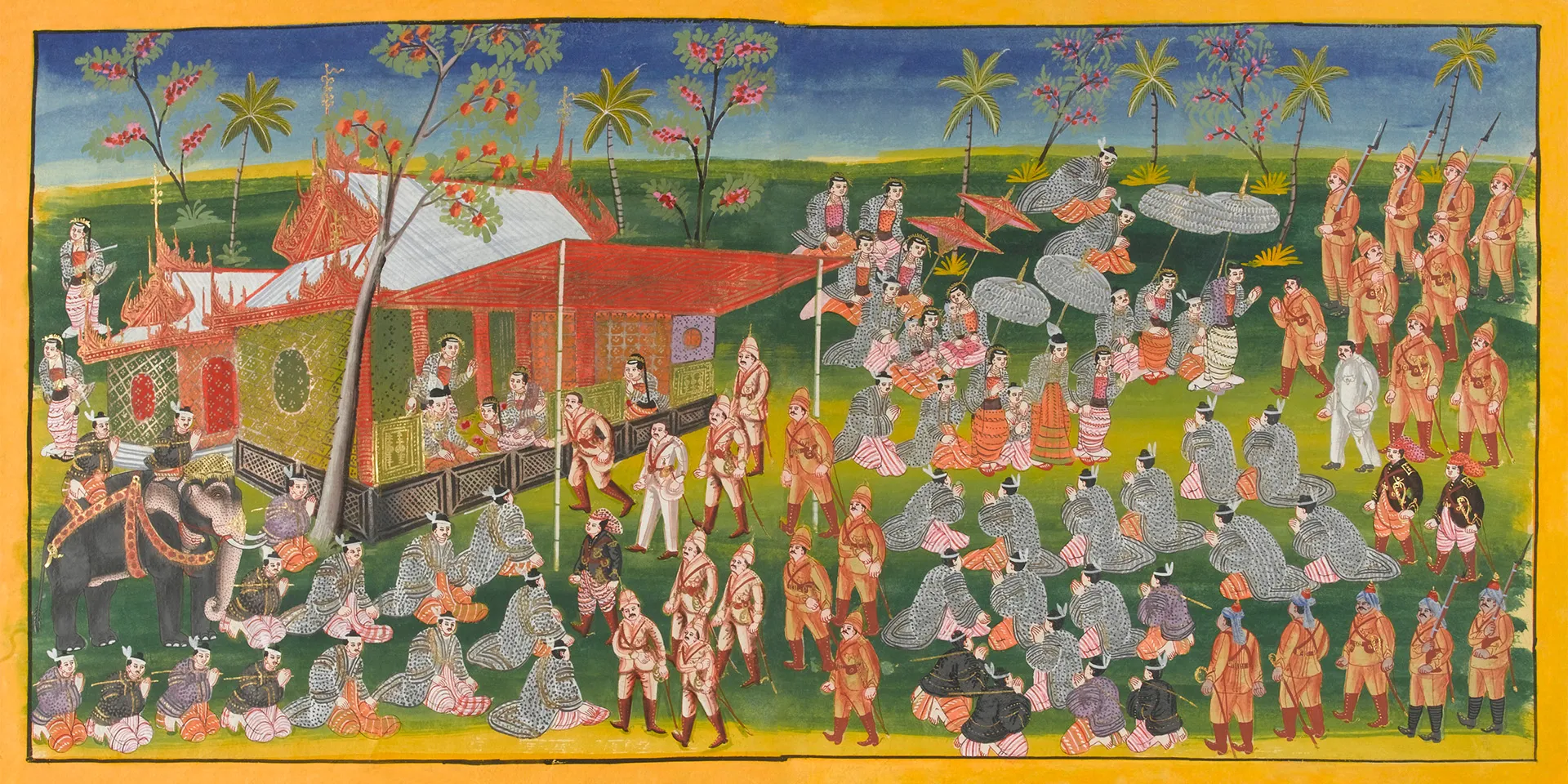
British forces occupy Mandalay on 28 November 1885 and King Thibaw surrenders the following day. The royal family is sent into exile in India, eventually settling in Ratnagiri on the west coast. The fall of Mandalay brings an end to the Konbaung dynasty — rulers of Burma since 1752.
26 February 1886
Annexation of Upper Burma
After Thibaw’s removal, Britain formally annexes Upper Burma. All territory of the former Burmese kingdom now becomes a new major province of British India.
1886–95
Resistance in Upper Burma
Despite the annexation of Upper Burma, local resistance prolongs the Third Burma War for several more years. This period witnesses ongoing suppression of so-called ‘dacoits’ (disbanded Burmese soldiers and bandits) and expeditions against hill communities.
‘I have been sent by the Viceroy to try my hand at the pacification of Burma… I have already made preparations for a series of combined movements, some of which have indeed commenced, but I am averse to incurring responsibilities in the outskirts of the province until we have got the heart of the country well in hand. Although I see no prospect whatsoever of a speedy pacification.’General Frederick Roberts in a letter to Lord Lytton, the former Viceroy of India — 20 November 1886
1886
Burma Police Levy
The Burma Police Levy is formed, later known as the Burma Military Police. By 1913, it numbers 15,350 men and is responsible for imperial policing across the province. This follows on from the formation of the Manipur Levy (1824), the Assam Local Militia (1827) and the Kuki Levy (1850) to carry out similar roles in their respective regions.
1891
Manipur War
The Chief Commissioner of Assam marches on Imphal, the capital of neighbouring Manipur, following a palace coup. The previous year, the Maharaja of Manipur had been forced to abdicate during a succession dispute led by his half-brother Tikendrajit Singh, the head of the army.
April 1891
End of independence in Manipur
The Manipuris are defeated at the Battle of Khongjom. Imphal is occupied and Tikendrajit Singh is captured and executed. Manipur comes under British supervision.
1911–12
Abor Expedition
Major General Sir Hamilton Bower leads a punitive expedition against the Abor (Adi) people in northern Assam after the murder of British officials.
1916
Assam Labour Corps
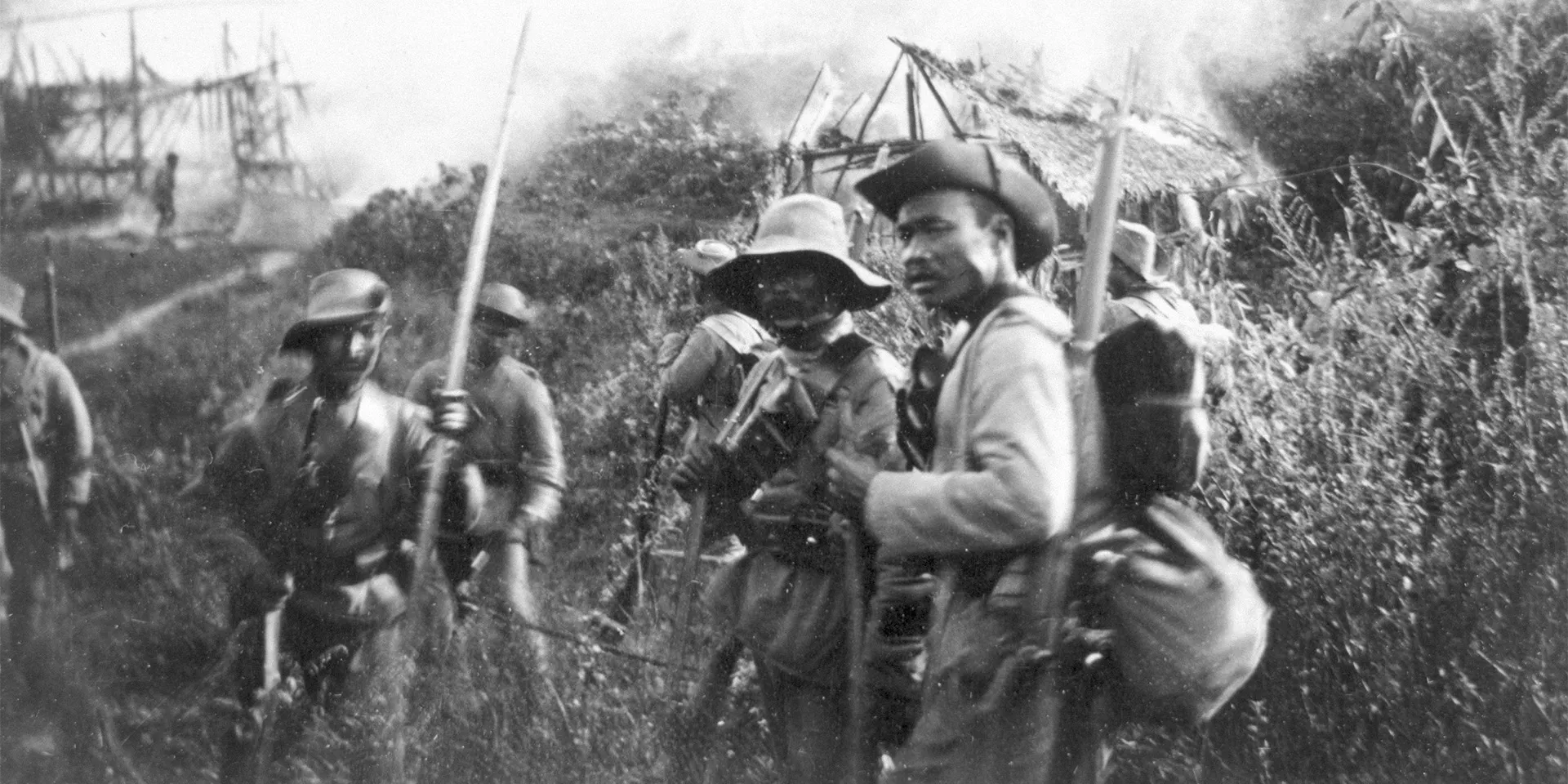
The Governor of Assam offers to raise 8,000 labourers from the region for service in the First World War (1914-18). These men set out for the Western Front in May 1917, with many returning home the next year.
1916–17
Burma Rifles
Two pioneer companies are raised in Burma in 1916. The following year, this is expanded to four companies and converted to infantry as the 70th Burma Rifles. Five battalions are raised, but only the 1st and 2nd take part in the First World War, serving in the Middle East.
1917
Assam Rifles
The Assam Rifles is formed from military police units across the province, making up four battalions. A fifth battalion is raised in 1920.
1917–19
Kuki War
Efforts to recruit more wartime labourers in the hill regions along the India-Burma border spark a rebellion by the Kuki (Zo) people. In December 1917, Lieutenant General Sir Henry Keary leads a military column against them. The rebellion is eventually suppressed by the Assam Rifles and the Burma Military Police, and the Kuki lands are brought under tighter British control.
1923
20th Burma Rifles
In the wake of the First World War, the Indian Army is reorganised from single-battalion units to regiments of three-to-five battalions, along the lines of the British Army, plus a training battalion. The 70th Burma Rifles becomes the 20th Burma Rifles, comprising three active battalions and a training battalion based at Maymyo (now Pyin Oo Lwin).
1930–31
Saya San rebellion
Amid growing rural dissatisfaction and rising nationalist sentiment in Burma, a political activist known to his supporters as Saya San sparks an uprising in the Tharawaddy district. The rebellion quickly spreads further afield. In August 1931, San is captured and the movement is suppressed. He is sentenced to death and hanged on 28 November.
1937
Formation of the British Crown Colony of Burma
On 1 April 1937, Burma gains limited self-government as a Crown Colony. Dr Ba Maw, who had defended Saya San at his trial, becomes the first Burmese prime minister.
1940
Expansion of the Burma Rifles
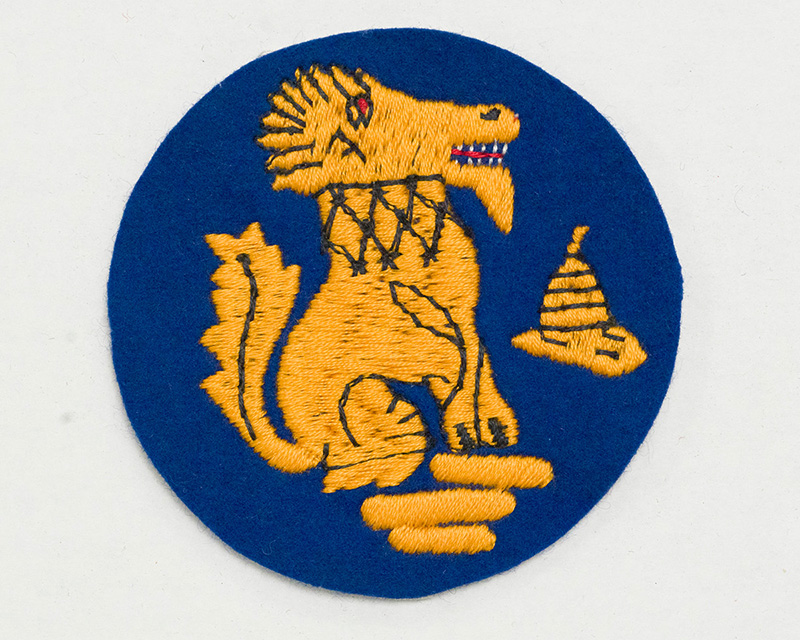
Following the outbreak of the Second World War (1939-45), the Burma Rifles is expanded to eight battalions. Its 7th Battalion is formed from the Burma Military Police.
1941–42
Japanese advance into Southeast Asia
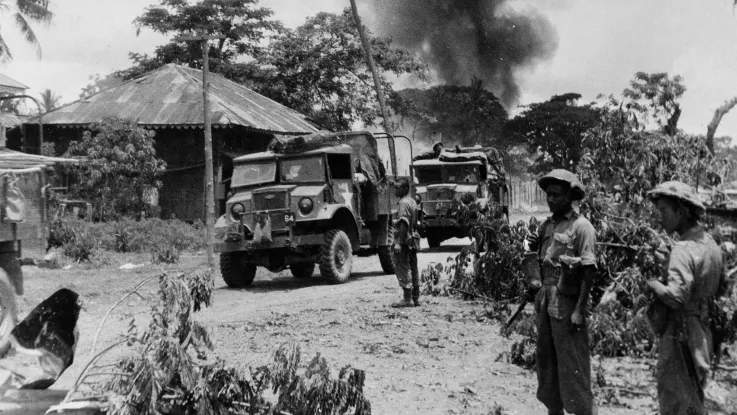
From December 1941 to May 1942, the British Empire suffers the most humiliating series of defeats in its history. Hong Kong, Malaya (now Malaysia), Singapore and Burma all fall to the Imperial Japanese Army in rapid succession.
January-May 1942
Retreat from Burma
As the Japanese Fifteenth Army advances into Burma, aiming to protect the flank of the earlier attacks and cut the American supply route to China, British Imperial forces begin a gruelling withdrawal towards India. This is the longest retreat in British military history.
September 1942 – May 1943
First Arakan Offensive
This disastrous attempt to recapture the coastal Arakan region of Burma is undertaken by partially trained and demoralised troops, with an inefficient command structure. British and Indian soldiers encounter Japanese defensive bunkers for the first time, to which they have no answer.
February–April 1943
Operation Longcloth
An experimental new formation known as the Chindits embarks on its first mission into Burma. Led by Brigadier Orde Wingate, its objective is to disrupt Japanese lines of communication and to test the effectiveness of long-range penetration tactics.
March–August 1944
Operation Thursday
Now six times larger, the Chindits embark on their second operation. Around 23,000 fully trained men are deployed to support the Chinese and American advance into Myitkyina in northern Burma and attack the Japanese lines of communication once again. However, after Wingate’s death in an air crash on 24 March, the Chindits become involved in attritional infantry battles for which they are neither equipped nor trained.
March–July 1944
Operation U-Go
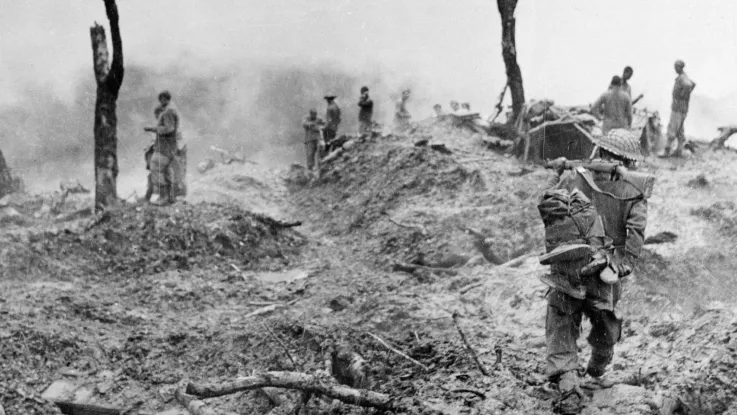
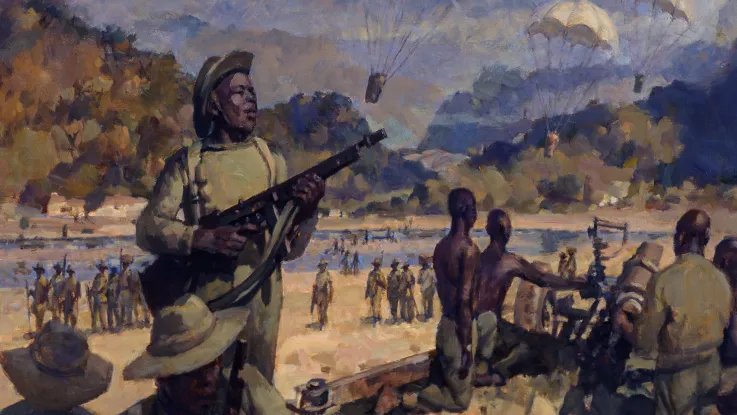
The Japanese mount an incursion into Northeast India to capture the supply base at Imphal and forestall an anticipated Allied invasion of Burma. Relying heavily on air supply, the defending British and Indian soldiers inflict a major defeat on the Imperial Japanese Army at the Battles of Imphal and Kohima.
3 May 1945
Capture of Rangoon
Following a series of defensive battles, General Bill Slim makes plans to fight in the open plains of central Burma. The ensuing Operation Extended Capital is a complete success, with the Allies retaking the cities of Mandalay and Meiktila. This allows the Fourteenth Army to advance to Rangoon before the monsoon breaks.
12 September 1945
Victory over Japan
Admiral Lord Louis Mountbatten accepts the surrender of the Japanese forces in Southeast Asia at Singapore. The ceremony takes place in the Municipal Building, with General Seishirō Itagaki signing on behalf of the Imperial Japanese Army.
1942
Formation of the Burma Defence Army
Trained and armed by the Japanese, the Burma Defence Army (BDA) is established to help resist the British. Its commander is General Aung San.
August 1943
Burma National Army
As Japan proclaims the nominally independent State of Burma, the BDA is reorganised as the Burma National Army (BNA). Colonel Ne Win assumes command, with Aung San becoming Minister of Defence.
1944
Anti-Fascist People’s Freedom League
The Anti-Fascist People’s Freedom League (AFPFL) is established by Burmese nationalist leaders to co-ordinate resistance against the Japanese occupation.
27 March 1945
Shift of allegiance for the BNA
After secretly negotiating with the Allies, Aung San leads the BNA in a nationwide uprising against the Japanese. The revolt coincides with the Allied advance into central Burma and marks a decisive shift in Burma’s wartime allegiance.
September 1946
The Great General Strike
Amid widespread industrial action, Aung San (now head of the AFPFL) is appointed to the Executive Council along with five other members of his coalition. This gives them effective control of Burma’s highest governing body. As a result, most of the strikes end within a week. The British authorities quickly realise the futility of resisting the demand for independence.
9 April 1947
Landslide victory for the AFPFL
Elections to the Constituent Assembly deliver an overwhelming victory for the AFPFL. The new Assembly establishes a committee to draft a constitution for an independent Burma.
19 July 1947
Assassination of General Aung San
Aung San and several other members of the Executive Council are assassinated in a plot led by political rival U Saw. The agreed timetable for independence remains unchanged, but the emerging Burmese state is deprived of its principal architect.
18 October 1947
Anglo-Burmese Treaty
Following unanimous approval of the draft constitution in September, Britain and Burma sign a treaty formally confirming the transfer of power and the terms of independence.
4 January 1948
Independence Day
After more than a century of British rule, Burma becomes an independent state.
See it on display
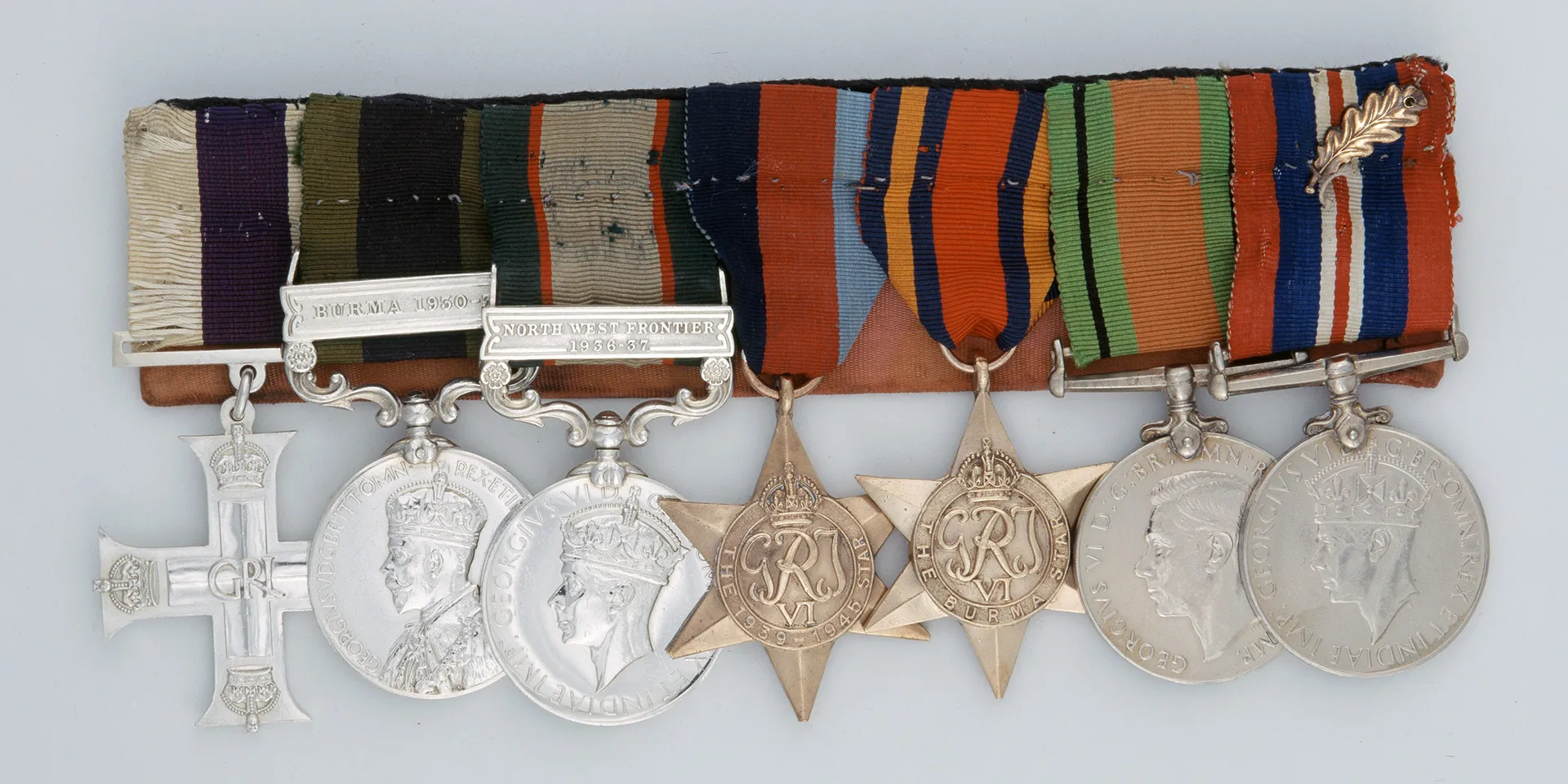
You can see Brigadier Smith Dun's medal group and find out more about the experiences of soldiers in Burma during the Second World War in our special exhibition, 'Beyond Burma: Forgotten Armies'.
Explore further
Beyond Burma: Forgotten Armies
First Burma War
Second Burma War
Third Burma War